
Back in my student days, in Leeds, our local greengrocer and his wife (unexpectedly for such a trade) were ardent socialists and this was reflected in their holiday choices. One such choice was Albania, then the fiefdom of the tyrannical and paranoid renegade, Enver Hoxha. They loved it, though she got a chicken bone lodged in her throat… a condition from which she never fully recovered. Their enthusiasm merely added to my fascination with this secretive destination, and yet the best part of half a century would pass before I would finallly get to set foot there.
Fortune finally presented itself in the shape of an inward investment conference in the capital, Tirana, and the promise of export grant to towards my attendance.
You don’t have to spend long in Albania to get the feeling that, never mind Groundhog Day, this is Groundhog Country. More than 100 years since events in the Balkans precipitated the First World War, the turbulent region finds itself at a new ‘soft frontier’ between the West and Russia and I encountered among many of those I met fears that the EU’s internal distractions could compromise the faltering progress made since the fall of communism.
While an uneasy truce seems to prevail since ongoing student protests eventually toppled the country’s Education and Science Minister, Lindita Nikolla, earlier this year, the controversial 2015 law that first sparked the protests remains in place.
And so the next protest never seems far away – indeed, the student variety seems to be no more than a bookend to other protests by groups from the diaspora, to anti-road campaigners, to miners, opposition parties, small business owners and oil companies.
All protests are enacted against the habitual backdrop of accusations of corruption in public life and of politicians being in the pockets of international drug traffickers and worse.
Genc Sejko, an Albanian living in the UK, has been the unofficial leader of diaspora protests, and the demands of his group, under the slogan Nën një flamur (Under One Flag), seem to encapsulate the sentiment behind many of the protests. Albanians abroad demand a homeland in which all citizens might flourish, without the young and ambitious having to seek their fortune overseas.
Prime Minister Edi Rama, facing renewed opposition attacks on his integrity, has been sufficiently rattled by the ongoing protests to sack half his government.
Rama is the former mayor of Tirana and his Socialist Party led a centre left coalition to power in 2013 on a promise of ending corruption and graft. But these days, weary Albanians ruefully reflect that they’ve heard it all before.
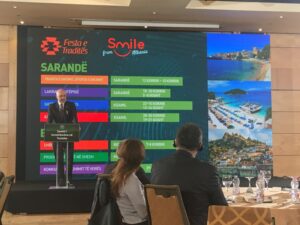
Prime Minister Edi Rama speaks at the conference
Ever since the fall of Communism, it is corruption allegations that arrive like buses, weakening the rule of law in a country whose reputation across the rest of Europe obscures its many extraordinary natural and other assets.
Against this familiar backdrop Monika Kryemadhi, Chairwoman of the small but vocal opposition party, the Socialist Movement for Integration, recently chose the website European Interest to launch an impassioned plea to EU politicians to help Albania to exit this vicious circle by giving the green light to accession talks later this year.
“Since Albania was granted a candidate country status in 2014, the process has decelerated,” she wrote. “Today we are faced with an unpredictable process, lacking a clear roadmap, which makes our European prospects appear less tangible.”
While former Soviet Bloc countries, most especially Poland and the Baltic States, seem to have enjoyed a relatively frictionless move into the European mainstream, Albania’s journey after the fall of the isolationist Stalinist dictatorship of Enver Hoxha, was never going to be easy. And it got worse in the late 90s when pyramid investment schemes, some government-sponsored, collapsed, costing many citizens their savings and leading to the temporary collapse of law and order.
However, Albania joined Nato in 2009 and its citizens have enjoyed visa-free travel to the Schengen countries since late 2010 – achievements for which the centre-right, which ruled for a time early this century, never tires to claim credit.
Currently the country receives €1.2 billion pre-accession development aid annually from the EU and yet, despite broad commitments to start negotiations as recently as last summer, it remains – with the newly renamed Republic of Northern Macedonia – the only candidate state not to have at least begun that process. Even “forgotten” Turkey is ahead on that criterion.
But Kryemadhi senses a waning of enthusiasm for expansion in Brussels. “EU commitment to Enlargement Policy appears to be waning, under the pressure of Brexit, migration, and terrorism, which dominate the political agenda,” she writes. “And yet, Albania is at the crossroads, in urgent need of EU support.”
This support is essential, she says, to help Albania to build strong social and democratic foundations; to weaken ties between government and organised crime; to bring transparency into government contracting; to complete planned infrastructure improvements.
She concludes: “Albania needs a green light as well as a tough merit-based process, not only for the sake of the result but also for the catalytic role of the accession talks in its own right.”
There is another reason why the EU might be mindful of goings-on in the Balkans. Some in Albania accuse the EU of “pampering” Serbia at Albanian expense, and effectively seeking to fast-track Serbian accession, aware that Russia is playing a much lower key but possibly more effective game.
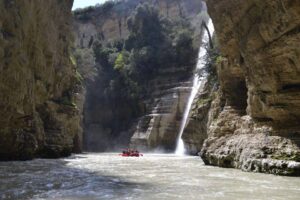
Albania’s mountain heartland appeals to the adventurous traveller
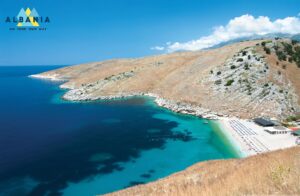
The Albanian Riviera remains largely unspoilt, though corruption and the lack of wholly robust legal system continue to temper the enthusiasm of investors
As Michael Birbaum, the Washington Post’s Brussels bureau chief, puts it: “Across Serbian life, the Kremlin has been expert at finding ways to attract friends and good publicity at bargain prices.”
Recent Russian tactics have included the gifting of half a dozen MiG fighters, but – perhaps more importantly – it has stepped into the disputed territory of Kosovo as a “mediator” to help resolve the long-running question of sovereignty – an area in which Nato and EU have largely failed.
But Roland Bejko, a city councillor with the opposition right-leaning Democratic Party in the southern city of Gjirokastra, pooh-poohs the idea of EU favouritism towards Serbia.
“Anyone of the Albanian officials who says the EU is unilaterally favouring Serbia in the European accession process, simply wants to justify the failure of the Socialist government,” he says. “I am convinced that each country is evaluated for the reforms and measurable achievements by approaching the fulfilment of the ‘Copenhagen criteria’, which define whether a country is eligible to join the EU.
“Unfortunately, the Albanian government is far from fulfilling these criteria, and as such I do not believe that the Eurocrats will be sympathetic towards starting the accession negotiations in June.”
Kosovo too is a complicating factor, as it is one that is very close to Albanian hearts: most Kosovars are ethically Albanian and speak Albanian and Albanians continue to celebrate the anniversary of the foundation of the League of Prizren in 1878, whose aspiration is the realisation of a notional “greater Albania” uniting all peoples sharing language and ethnicity.
And so a low-grade tussle continues, as Albania plans to scrap all trade barriers and tariffs with Kosovo by the middle of this year, Kosovo has slapped high tariffs on what it claims are heavily subsidised goods from Serbia destined for the Kosovar Serbian minority. The EU appears powerless to intercede, perhaps for want of upsetting Serbia, but also because a number of EU members have not followed the European Parliament, which called on all members to recognise Kosovo as long ago as 2010.
Into this vacuum have stepped some individual EU members to offer help to Albania in developing its infrastructure. Germany is a major benefactor, but on a smaller scale, Slovenia is lobbying hard for its Adriatic near neighbour to begin accession talks this summer, while Bulgaria has pledged practical assistance in the process.
Perhaps more significant are the activities of Turkey and China, as the former continues to seek to extend its regional sphere of influence. Turkey says its investments in Albania total $2.5 billion and Turkish interests are in place to build a controversial new airport on Albanian Riviera, at Vlorë, while Turkish money is behind the latest faltering attempts to set up a national airline.
China sees in Albania a country rich in minerals and with immense tourism potential and Chinese investment in the country today is probably at its most significant since China was just about the only friend of Enver Hoxha.
So where does this leave Western economic interests? There are at least clear signs that the country’s undoubted tourism potential holds the key. At a tourism investment conference I attended recently in Tirana, there was a mood of general optimism, epitomised by the announcement that Marriott was among international brands moving in. It will develop a five-star hotel in Tirana, while there are other significant coastal developments planned, by such as Hilton, Hyatt and Best Western.
“This year Albania has had its best tourist season, with six million visitors,” Prime Minister Edi Rama told delegates, with the assurance of a man who believes he can ride out the latest political storms. That equates to six per cent revenue growth against four per cent GDP growth.
He and others set out a coherent policy framework for the industry, with an emphasis on sustainable development, backed by a re-energised rail network and other new infrastructure, alongside exploitation of the country’s rich culture and cuisine, spectacular mountains, dramatic coastline, turquoise lakes and remarkable Roman and Ottoman World Heritage Sites.
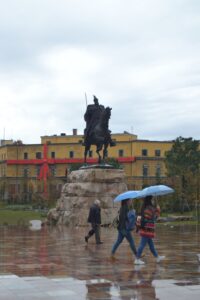
My journey south through Albania was so blighted by rain that even the sat nave in my hire carried a brolly
On the face of it, the 100 Villages programme sets out an impressive model of cooperation between central and local government agencies to deliver sustainable tourism embedded in and for the benefit of local communities. However, Bejko scoffs: “It’s yet another half-baked idea which has only been implemented in a few villages, which happen to be the home villages of members of the current government.”
Gillian Gloyer, author of The Bradt guide to Albania, which remains the only commercially published English language guide to the country, is a committed Albanophile who has learned the language and spends much time in the country. But she shares the widespread sense of resignation in the face of what she sees as worsening corruption in some areas, and a readiness to slay the goose that lays the golden eggs by sanctioning environmentally damaging schemes.
“I think corruption is at a much higher level now than it was, say, ten years ago. In my view, the most visible examples of this government-level corruption include the rush to grant hydroelectric concessions on the country’s most unspoiled rivers, including some that are actually in National Parks.
“On the Valbona River, for example, 12 hydroelectric plants are planned – without the environmental impact assessments that the EU would usually require.”
However, Stela Dhami, Managing Partner in the Tirana office of Colliers International, the global real estate and investment management company, is fare more upbeat: “There is a strong motivation in the country to ensure that international standards of doing business and process are followed and to put clear water between the present and some of the more difficult past.
“Albania is opening up even more to international markets by the attraction of international brands who bring with them international standards and expertise, much needed in a developing economy.”
There have been false dawns for a people who’ve had more than their share of disappointment, but if government could actually deliver on what one delegate described as “the clearest message I have heard from a platform on destination development in many years”; and if the EU might bring itself actually to begin accession talks this year, then there just might yet be hope of reversing the migration flows. Sadly, both the If and the But still feel daunting…
- A version of this account was first published in The New European


I didn’t know anything about Albania.
Now I really want to go.
The country did, in many ways, defy my expectations… not least by raining incessantly, though it was December! It has a good tourism product, but most visitors come from Kosovo and other neighbouring countries, rather than western Europe. It has superb kiking trails and an astonishingly rich history and heritage. Today any of its society’s structural shortcomings can be laid at the door of government-encouraged Ponzi schems that collapsed and left people in abject poverty (and many of them armed to the teeth) in the wake of the fall of communism. As a generalism, I don’t think the West a) did enough to help such countries at the time and b) took a far too gloating stance against the former Soviet Union. A more conciliatory approach might have enabled many former Soviet Bloc countries (and Albania and Yugoslavia) to act as a more neutral bridge between East and West. That’s so much history now, but we see what’s being played out in Ukraine and Bealrus and, for that matter, over the decades in Georgia too adn thinnk “If only, what if?!”.
I visited the mysterious Albania in September 2019 and
I remember talking to some locals who were despairing at the corruption of the government and local officials. I quickly sensed their helpless frustration at the injustices surrounding them.
My trip was curtailed as I was staying in what became the epicentre of the worst earthquake Albania had suffered in 30 years. I want to return.