
Neolithic and Bronze Age stone circles find themselves in unexpected company with an electric bicycle in the rain: an author’s odyssey; or was it idiocy?
Once upon a time, in a far off land in the days before COVID, I was commissioned to write three books for Saraband, a modestly-sized but highly respected publisher, based in Manchester.
The first of these was a narrative non-fiction account of a walk from Settle to Carlisle (just published), loosely following the route of that iconic railway along the backbone of England. The second was a reworking of my successful account of the long battle to save that same line from closure. And the third was an idea I had pitched almost on a whim: an account of a walk connecting stone circles in the North of England.
Why stone circles? Well, I’ve always had a fascination for them – in part, I think it’s down to the fact that they are among the few visible remains of an era in our own island history, which coincided with the building of the pyramids in Egypt, with the early great civilisations of Greece, with the earliest writing, around the Mediterranean, India, Easter Island…
By contrast, the people who lived in Britain and Ireland practised simple farming and gradually adopted bronze tools but left few clues as to how they may have actually lived their lives – apart from hut foundations, tombs, mysterious cup and ring carvings on stones, and traces of field systems. And many, many stone circles, ranging from the kind of mini-circle you might erect in your garden as a diversion during lockdown, right up to the magnificence of Stonehenge, Avebury, or the Stones of Stenness, on Orkney.
These circles hold a particular fascination for many people – to stand in the centre of one seems, somehow, for many of us to inspire a sense of calm, serenity almost. Indeed I had used three of Cumbria’s finest stone circles in my novel, The Episode, as places where the two non-sequential timelines of the book might mysteriously intertwine, somehow bonding characters from different periods.
My original idea for this stone circles book was to walk up the eastern flank of the Cumbrian Fells and then strike north-east across the Pennines to finish in Northumberland. But, although there are stone circles to be found as you cross the Pennines, the route would offer but sparse pickings in this its central section and so I opted instead to turn left, rather than right, and follow a horseshoe route around the Lake District.
Thus decided, I began the process of learning more about stone circles, and stone circles in Cumbria, in particular. My earliest and most significant discoveries were:
- There are a lot of stone circles in Cumbria – as many as 50 by some reckonings
- As a consequence, any walking tour of said circles could take at least two weeks.
Indeed, the more I planned my proposed walking route, the more hitherto unspotted circles I would come across… in accounts related to quite different subjects, or hidden in plain sight on a map. That was when I had the idea of doing my tour on my bike – but there’d be lots of hills and that would be a challenge on my 30-something vintage mountain bike. Ultimately the penny dropped and I recalled how, just a year previously, I had been quite blown away by the experience of trying out electric bikes on a media trip I’d led to southern Norway.
By this time, however, the UK was just emerging from its first COVID lockdown and everyone was rediscovering cycling. Cycle shops were struggling to meet demand, a situation made worse by supply chains stressed by reduced working at factories and compromised shipping arrangements.
I visited a friend’s cycle shop in Carlisle: such shops could stay open during lockdown, thanks to their health-giving mission. Owner Mike Lee said cycles were leaving the shop as fast as they could assemble them but he had a couple of cycles for me to try. Neither seemed to have quite the oomph I’d remembered from Norway. And then my eyes fell on a chunky hybrid machine in jet black slinking at the bnack of the showroom. It was love at first sight and a quick test-ride proved that my eyes did not deceive me.
It was a Giant E+ 2 hybrid, meaning it had decent off-road capability, without being a full macho mountain machine. I handed over my palstic and christened it The Beast.
I’d originally intended to get some stages of my circles route completed in 2020, but oscillating COVID regulations ultimately led to the postponement of this ambition until restrictions on overnight stays were finally eased, on May 17 of this year.
I joined the scrabble for available beds and booked a medley of pub rooms, Airbnbs and a youth hostel for my six-night, seven-day odyssey. Late additions to my route included a solitary circle, near Casterton, in the south of the old county of Westmorland, and possible circle on the fells high above Haweswater, with the result that my horseshoe route now looked more like a starfish – on the eastern side at any rate.
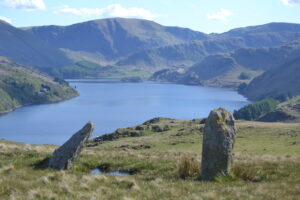
Standing stones above Haweswater – possible remains of a full circle
I was thankful that Northern Rail seemed not to be applying its two-cycle rule too rigorously as I embarked on a four-hour scenic route from Durham to Carlisle and on down the line towards Settle, to lofty Dent Station: it was the easiest possible start, a trial of my disc brakes more than anything else, as I wound down the few hundred feet to the valley floor.
The UK remained not locked down, but locked in the coldest, wettest May for years, as a weak jetstream funnelled countless depressions in from the Atlantic. But the towering cumulus clouds seemed to be giving me a decently wide berth as The Beast made light work of the long climb out of Gawthrop, just beyond Dent village.
Once at the summit, however, I could see the rain advancing towards me up Barbondale and so hastily donned full waterproofs. I’d planned to go off-road, taking a loop on a bridleway round the back of a hill. I thought better of this when confronted by two parallel rivers, masquerading as a track, advancing down the fellside. I’d copied my route onto small map sheets that I coudl discard as I used them, tand these were meant to sit inside the transparent top of my new handlebar bag.
I took my map out to find a new route. It had turned to papier maché in seconds and I had only a hazy idea of where my target circle actually was. By some miracle I found I had excellent 4G mobile coverage and Googled the circle megalithic.co.uk, where a member had, thankfully, recorded quite detailed instructions on how to find the circle.
The circle proved small but rather perfectly formed, and I could see Morecambe Bay in the moments when the rain relented a little, though my phone then fell casualty to water ingress.
I had hoped that my battery would last me the full day’s 30kms or so, but my heavy load and the steep climbs determined that I would need to take a few coffees while The Beast recharged at the Barbon Inn. Indeed, from that day on, I made a point of recharging at least once a day, a full charge from quarter-full or so taking up to an hour.

Long Meg gazes upon her daughters
I was thankful I’d done the top-up as my battery then ran out with little warning just short of Tebay, leaving me to slog the last mile or so to my first overnight stop on full human power.
My subsequent journey was one of highs – and a few lows. Cycling to 1,000ft above Haweswater to gaze down on the shimmering early evening blue of the lake, framed by two standing stones; people enjoying the tranquillity of Long Meg and Her Daughters; the extraordinary collection of five circles high above Eskdale; the remarkable hut foundation and tomb remains above Devoke Water; returning to my favourite circle, Sunkenkirk, near Broughton-in-Furness; journey’s end at the double circle on Birkrigg Common, overlooking Chapel Island, in Morecambe Bay.

Cairn above Devoke Water
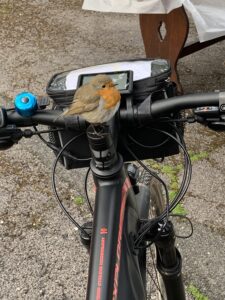
Can I come alongtoo please?!
The lowest of the lows came on Wednesday May 19 after I recharged The Beast in a café at Pooley Bridge. The rain began to fall in curtains. Curtains of the full-blown wet velvet kind, that bucked and billowed in a capricious wind off Ullswater. I was headed for the old coach road over the fells – six or seven miles of pure off-road, but my earlier experience made me wary and I struck off instead to ride the A66, splashed and blown about by heavy lorries and inconsiderate car drivers. I took a selfie at the popular Castlerigg circle, near Keswick, for no better reason than to prove I had made it, despite the weather. I then took a wrong turning in Whinlatter Forest, adding miles and hundreds of feet of unnecessary climbing.
It was a bad day, eventually mitigated by the kindness of my Airbnb hosts at Gilgarran, near Ullock, who helped me dry each and every piece of my sodden kit.
The biggest physical challenge I faced came after Devoke Water, when my gamble that the route down from the fells would be more track than footpath backfired on me. I had to drag The Beast across soggy peat bogs and over tussocks of cotton grass and dwarf birch and hazel.
Then there were the frustrating hours spent searching for evidence of stone circles on limestone plateaux – a more apt simile, I thought, than needles in haystacks.
Good and bad collided the day I managed to find a delightful though well-hidden cairn circle, close by Center Parcs. I was thrown from The Beast as I caught a pedal on a hidden tree stump. Winded and a little shaken, I eventually and arrived at Leacet Hill, blood streaming from my knees and my head buzzing with the question “Have I broken a rib or just bruised it?”. A roe deer leapt from the circle and lifted my spirits; I spent several minutes enjoying the peaceful setting and the unusual granite stones.
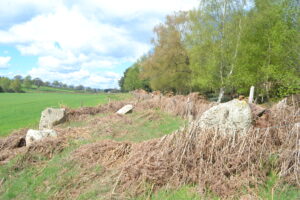
Found at cost – cairn circle at Leacet Hill
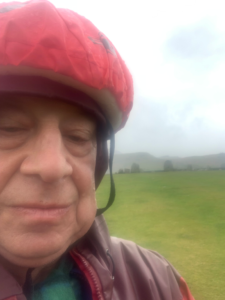
Very wet selfie at Castlerigg
But my fall had knocked my front dérailleur slightly out of line and I only managed a full repair once I got home, making it difficult subsequently to engage my lower ratio gears.

Sunkenkirk or Swinside circle, near Broughton-in-Furness is my favourite
That apart, The Beast comfortably got the better of every challenge I threw at him across 300 miles or so and it was with some surprise that I read this weekend that the Government was considering offering inducements to improve the take-up of electric cycles in the UK, which is, apparently, lagging way behind other European countries.
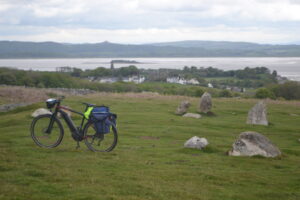
Journey’s end – Birkrigg double stone circle, near Ulverston
The Government sees such machines as highly efficient for converting short car journeys to cycle trips and that’s certainly been the case for me: unless it’s peeing down or blowing a hurricane, I now cycle. It’s an open and shut case.
But my Cumbrian circle line adventure last week additionally demonstrated just how much ground you can cover in a few days. I’ll be planning more of these longer adventures in the future, though may pare down my load a bit more. Maybe swap the laptop for a small tablet for starters.


Leave A Comment